Friday, September 16, 2011

Coral Bark and Turning Leaves

The Coral Bark Japanese Maple, or Acer palmatum 'Sango-kaku', is a graceful new addition to our garden this year.  While accompanying me on a trip to the plant nursery, Mr. Red House saw this tree and fell in love with its beautiful red bark.


In the spring, the leaves emerged a spring green rimmed in coral.


The delicately cut leaves then turned entirely green for summer.


Now with the promise of cooler weather ahead, a few of the leaves of the Japanese maple are starting change their colors again.  I can't wait to see it in its fall glory!


I love the leaves of this maple.  Usually the most prized feature, however, of this maple is not the beautiful foliage, but the bark.   The more mature bark is brown..


while the newer growth is red and can intensify to a brilliant salmon color in cold weather.


According to NC State's records on the Coral bark Japanese maple, my little bitty sapling can eventually grow to 20'-25' and 15'-20' wide.


That means I might be moving it a little further from the house this fall... (I seem to have a reoccurring issue with measuring!)  Hopefully I can find a spot in view from a window where I can enjoy those beautiful leaves and bark year-round!
Linking with Digging today for September's Foliage Follow-up.

Thursday, September 15, 2011

Red House Garden Blooms - September 2011

Today I'm joining May Dreams Gardens and garden bloggers around the globe in showing off those late summer blooms in our garden.


Our gardens are looking rather sad at the end of a long hot summer, but the persistant plants of the Red House Garden are hanging in there and joined by a couple fall bloomers.


Here are the front gardens with the orange zinnias, purple petunias, yellow cosmos, and white rain lilies still blooming away. 


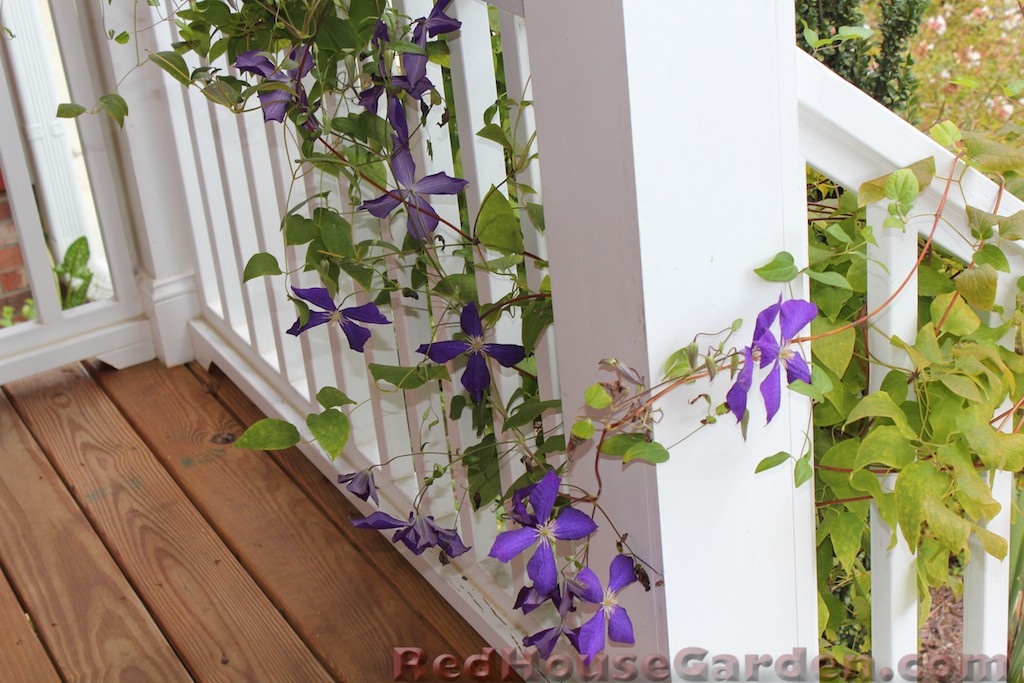
Up on the porch, the Clematis 'Jackmanii' is reblooming up a storm!


In another part of the front gardens, my Rudbeckia hirta 'Irish Eyes' are starting to bloom in front of the 'Little Richard' Abelia.


I grew these Rudbeckia from seeds this summer, and I wasn't sure if they would bloom this year, so I am very happy to see some bright cheerful blooms with all of that foliage!


Another pleasant find at the end of the summer are the forget-me-nots.  I planted some seeds last summer and those plants must have reseeded quite well, for now I find little forget-me nots scattered throughout the yard when I least expect them. 


One must also not forget the giant 'Kelvin Floodlight' Dahlias!


Continuing the yellow theme on the side yard is the Coreopsis with a couple red petunias.


These are supposed to be 4 o'clocks, but they've never been open at four in the afternoon in my garden!  I've only seen the blooms open in the morning.  Maybe the confused plant thinks that it is supposed to be blooming at 4am?


 On to the side yard.  Ignore those weeds in the path and focus on the impatiens! 


Much better!  I have single and double impatiens here in the shade garden.


The Hibiscus 'Luna Pink Swirl', nicotiana, and pentas are still in bloom on the other side of my weedy path.


In one of my containers, my 'Autumn Joy' Sedum is blooming with the petunias and lobelia.


And I couldn't resist buying some little violas when at the plant store the other day. A big stump section in what will be the Children's Garden had a hole in it, and I've been looking for a cute little plant to put there.  The violas will stay cheerful throughout fall and into our mild winter.

Happy Gardening!

Monday, September 12, 2011

The Swallowtails of Red House Garden

The large, striking swallowtail butterfly is one of the more commonly seen butterflies in North America.   Swallowtails are named due to their tails having a long, forked shape similar to some types of swallows.  Members of this butterfly family can be found on every continent except for Antarctica.

According to the North Carolina Butterfly Page by Jeffrey S. Pippen, there are eight different Swallowtail species that can be found in North Carolina.  Two of the species have been documented visiting the Red House garden - the Eastern Tiger Swallowtail and the Spicebush Swallowtail.  Hopefully as my butterfly gardens take shape, more of these beautiful visitors will come.

Eastern Tiger Swallowtail

The Eastern Tiger Swallowtail is very common in the eastern United States.  The male is yellow with black 'tiger' stripes (or, more accurately, black with yellow stripes).  Occasionally some blue may be found on the hindwings.

male Eastern Tiger Swallowtail
The female comes in two forms.  The first 'yellow' form looks much like the male, but with more blue on the hindwing.

female yellow Eastern Tiger Swallowtail
The second female form is the 'dark' one.  This one is dark brown or black, but you can still see the black 'tiger' stripes on the underside of the wings.  She also has orange spots on the underside of her hindwings.

female dark Eastern Tiger Swallowtail
The dark female type has blue on the hindwing similar to the yellow type. The butterflies in these photos have had an altercation with someone or something and have torn the back of their wings.

female dark Eastern Tiger Swallowtail
 The dark female Eastern Tiger coloring actually mimics the poisonous Pipevine Swallowtail, another dark colored butterfly with orange spots on the underwing, which provides protection against predators.  If there are more Pipevine Swallowtails in an area, there will be a higher percentage of dark female Eastern Tigers as opposed to yellow.  This is, no doubt, due to likely predators not wanting to take a chance on eating the dark, look-alike butterfly and risk falling sick.  We apparently do not have a lot of Pipevine Swallowtails around, as many of the dark female Eastern Tigers I've seen here look like something has tried to take a bite out of them.

female dark Eastern Tiger Swallowtail
In general, the female offspring of these Swallowtails will have the same coloring as their mothers.

female yellow Eastern Tiger Swallowtail
Host plants for the Eastern Tiger Swallowtail caterpillars include aspens, birches, black cherry trees, lilacs, sweet bay, and tulip trees.  Adult Swallowtails are attracted to nectar plants.  The males are also attracted to mud puddles, as they need extra salt and nutrients that the mud provides for mating.

Spicebush Swallowtail
 
Another Swallowtail visitor of the Red House Garden is the beautiful black Spicebush Swallowtail, which can be found throughout the Eastern United States.  The males have green coloring on their hindwings, while females sport a bluish hue.

female Spicebush Swallowtail
On the underside of their hindwings, Spicebush Swallowtails have orange spots - yet another dark colored butterfly with orange spots trying to pass itself off to possible predators as the poisonous Pipevine Swallowtail.

Spicebush Swallowtail
Another interesting attribute of many Swallowtails including this one is that, unlike most butterflies, they do not always land on the flower or plant to feed or lay eggs.  Instead, they often hover in place over the flower while holding themselves in place with their feet.

Spicebush Swallowtail
Thus they look like they are constantly fluttering while feeding.

female Spicebush Swallowtail
As one can guess from the name, the main host plant for the Spicebush Swallowtail is spicebush.  Sassafras and bays are sometimes used as well.  The adult Spicebush is attracted to nectar plants such as Joe-pye weed, lantana, and this buddleia.


Come again soon, beautiful Swallowtails!
You are always welcome at the Red House garden!

linking with Macro Monday today

Friday, September 9, 2011

Persistent Plant Awards

My garden beds are starting to look rather bedraggled after the long summer, and let's not even talk about the lawn!  But I still have a few spots of color in my garden thanks to some hardworking flowering machines.  It's time to give credit to those worthy plants that are still going at the end of the summer.   Beware, this post is photo heavy.


First off is ANNUALS.  Here's a hand for diligently doing your job.


My wave petunias and orange zinnias keep going and going!

Cosmos sulphureus
 Cosmos which I grew from seed are still blooming.

Cosmos bipinnatus
 I have petunias in several different places.  I know they're common, but there's a reason why!

petunias with sedum 'Autumn Joy' that is starting to bloom
On to the PERENNIALS.  Between the coreopsis and rudbeckia, the yellows seem to have it.  All those still blooming, stand up and take a bow!

Coreopsis
Rudbeckia hirta 'Goldilocks' was grown from seed.


Also grown from seed, Rudbeckia hirta 'Irish Eyes' livens up an otherwise dull spot.
The very tall Rudbeckia nitida 'Herbstonne' enjoying a second flush of blooms.

I'll go ahead and put the Dahlia 'Kelvin Floodlight' in this category.  I took a chance and left it in the ground after last year, and it has come back and is still blooming. 

Dahlia bud starting to open

On to my favorite - VINES.  Several of my clematis vines are reblooming, and one never stopped - definitely worthy of a Persistent Plant Award!

Clematis 'Rooguchi' has been blooming all summer.
Clematis 'Jackmanii' starting to rebloom.
the beautiful Clematis 'Guernsey Cream'
the teeny, tiny bell-shaped flower of Clematis pitcheri

Last but not least are the blooming SHRUB awards.  The butterfly bushes are the star of this category, with Buddleia davidii 'Santana' winning MVP of the garden.

 'Santana' has been attracting butterflies all summer long.
The award for 'Most Improved' goes to Buddleia davidii 'Harlequin'.  I thought it had succumbed to fungal diseases from the wet spring, but it's back!


First frost date isn't for a few more weeks, so here's hoping for that these hardy plants keep persisting awhile longer.  An extra special award for any plant that would like to keep on blooming until spring!  A gardener can hope right?