Showing posts with label Birds. Show all posts

Saturday, February 14, 2015

How to Tell the Difference Between a Downy Woodpecker and a Hairy Woodpecker

While the little Downy Woodpeckers are very common at bird feeders, the shier Hairy Woodpeckers will come to feeders as well, and it can often be tricky to tell the difference between the two.

Here is a picture with a Hairy Woodpecker on the left and a Downy Woodpecker on the right:

left: Hairy Woodpecker  right: Downy Woodpecker
The most immediate difference you can see is that Hairy Woodpeckers are much larger than the diminutive Downies.  When I first noticed the Hairy Woodpeckers coming to my feeder, my first thought was, 'Woah, that's a large Downy Woodpecker!'

Hairy Woodpecker with Goldfinches
Apart from their size, the easiest way to identify which is which is to look at their bill.  Hairy Woodpeckers have very long, chisel-shaped bills.  The bills are about as long as their head is wide.

Hairy Woodpecker
The Downy Woodpecker, on the other hand, has a small bill.  It is only about 1/3 of the width of their head.  The Downy's bill also has a more noticeable downy tuft of nasal bristles around the base of it.
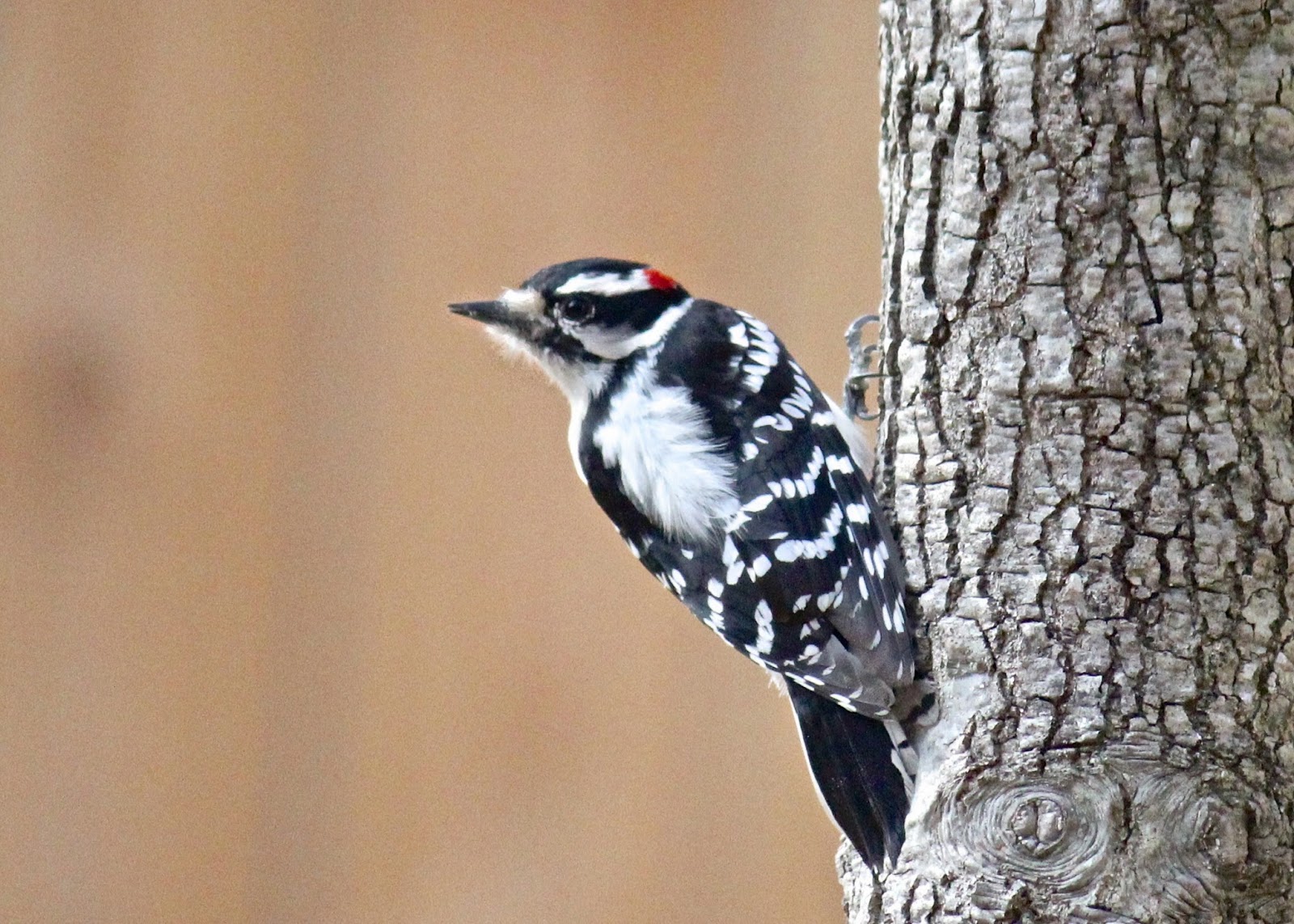
Downy Woodpecker
There are also a few subtle coloring differences: 

DOWNYHAIRY
NECK:
more rounded white patch
more uniform band of white
TAIL:
white outer tail feathers barred with black (looks spotted)
usually pure white outer tail feathers (at least in Eastern US)
BREAST:
subtle black mark on breast, if at all
distinctive black mark on breast


One more difference can be found with the male woodpeckers.  The males of both species have a red patch on the back of their head, but if there is a black line running through the middle of it, it is mostly likely a Hairy Woodpecker.

left: Downy Woodpecker  right: Hairy Woodpecker

So think you know the difference between a Downy and a Hairy?
See if you can tell which is which in these pictures... some of them are tricky!

1. 

2. 

3.

4.


Ready for the answers?

Here they are, as well as some of the distinguishing marks in the pictures.

1. Downy - (you can see the small bill)
2. Hairy -  (large bill)
3. Downy -  (large, rounded white patches on back of neck and spotted tail feathers)
4. Hairy -  (the bill looks larger, there is a distinctive black mark extending onto breast, and the band of white at the neck looks like a narrow, uniform stripe as opposed to a rounded patch)

So how did you do?  It's definitely harder when they aren't on a bird feeder, so there's no relative frame of size!

left: Hairy Woodpecker  right: Downy Woodpecker
Don't forget to show the birds some love this weekend and count the birds
for the Great Backyard Bird Count if you can!

Monday, February 9, 2015

Common Backyard Birds of the Eastern US

When I first started feeding the birds a few years ago, I had no idea which birds were which.  With the Great Backyard Bird Count coming up (Feb. 13 - 16!), I thought I would post a list of birds commonly seen in yards and at feeders to help new bird watchers identify them.  

Here are ten birds that are frequently seen here in the Eastern US:

1. Chickadee
If you put out a new bird feeder, this is usually one of the first birds you will see!  This is the little round bird with the black and white head.

There are two slightly different species.  In the North, it's a Black-capped Chickadee. In the South, it's a Carolina Chickadee.  If you live in the small band in the middle where there is overlap, you'll have to look a little more closely.  The Sibley Guides website has a good article about the differences.

2. Tufted Titmouse
The Tufted Titmouse is the gray-backed bird with a little tuft of hair on top.  So cute!

3. American Goldfinch
The American Goldfinch is a small finch that comes to feeders in flocks.  In winter, they only have a little yellow on them, but in spring, the males turn flamboyantly golden yellow!

4. Northern Cardinal
Most people can spot a Northern Cardinal pretty easily. The female has more brown on its body, but still has the signature red bill, wings, tail, and crest.

5. House Finch
A male House Finch is fairly easy to spot, with a red face and chest.  The female is harder, being one of those nondescript brown birds with a brown-and-white streaked chest.  I usually can tell it's a House Finch from the beak, which is wide, much like a Cardinal's.  
(I call this the bird with the 'chompy' beak.)

6. Downy Woodpecker
One of my favorites, the common Downy Woodpecker is a teeny-tiny woodpecker that loves bird feeders.

7. White-breasted Nuthatch
Much like Woodpeckers, you will see Nuthatches scrabble up and down tree trunks.  They crane their head up at an astonishing angle and then zoom to the bird feeders.  The common White-breasted Nuthatch has a blue-gray back and a white face and breast.

8. Dark-eyed Junco
You'll often see flocks of little white-bellied Dark-eyed Juncos hopping around on the ground in search of food.

9. Mourning Dove
photo source - Wikipedia, photo by Almaden Lake
See a large bird strutting around on the ground making sad cooing sounds?  It's most likely a Mourning Dove.  

(Don't get confused!  A similar looking, though less common bird is the invasive Eurasian Collard-Dove, but it has a distinctive black 'collar' around the back of its neck.)

10. American Robin 
American Robins are large birds that you often see hopping around on lawns looking for earthworms. 

I hope that helps get some new bird watchers started!
For more visual aids, the Great Backyard Bird Count has a great list of the most common birds, and Project FeederWatch has an even more extensive chart.

So what is the most common bird in your backyard?  
Happy bird watching!

Thursday, February 5, 2015

Coming Soon: The Great Backyard Bird Count!

Coming soon to a backyard near you: the Great Backyard Bird Count is almost here!  Every year the kids and I participate, and it can be quite a lot of fun!

So what is the Great Backyard Bird Count?
From February 13 - 16 this year, everyone is being asked to count how many and what type of birds they see for at least 15 minutes, then log their results at the GBBC website.  Last year over 140,000 people in 135 different countries participated and counted over 17 million birds!
That is a powerful lot of data, people.

2014 Statistics from GBBC
The Great Backyard Bird Count was started in 1998 by the Cornell Lab of Ornithology and the National Audubon Society.  Some of you might know about the Cornell Lab from their online bird guide, All About Birds.  When trying to identify a bird, that is usually where I end up!  My favorite feature of their online guide is the 'Similar Species' sections.  As long as I know what bird it sort of looks like, I can go to their bird guide and browse through birds that look similar, and then usually I'll find it.


Hmm, still having trouble identifying this bird...
The data from the Great Backyard Bird Count helps researchers track bird populations.  Due to weather, habitat changes, or other factors, different species will increase or decrease.  Bird populations will move, sometimes migrating to new locations.  Last year's data showed the effects of the cold 'polar vortex' in the US, a finch 'superflight' to new locations due to food shortages in Canada, certain Mexican species moving north due to climate change, more Snowy Owl invasions into the US from Canada, and a surprise Yellow-Rumped Warbler that somehow made it all the way to England from North America!

female Yellow-Rumped Warbler
In honor of the Great Backyard Bird Count, the next few blog posts will be focused on birds and birding.  Ever since Mr. Red House and the kids gave me my first bird feeder several years ago, I've gotten really into bird watching.  It's so much fun, and I especially appreciate it in winter, as it connects me to the outside when the cold weather keeps me inside.


So mark your calendars for February 13 - 16!  I wonder what the data will show this year?


Are you planning on participating?

Tuesday, January 27, 2015

Blizzards and Birds

A large winter storm has hit Massachusetts, causing blizzard conditions.  It started snowing yesterday around noon and isn't supposed to let up until tomorrow morning.  School for the kids is cancelled today for the blizzard, and tomorrow so that we can all dig ourselves out.

Downy Woodpecker
We've been out with the snowblower twice, trying to keep up with the storm so we've got a chance of getting our cars out whenever this ends.  The snow was up to my knees and rising.

American Robin
We are lucky to be able to hole up in our nice warm houses.  The birds, on the other hand, still have to venture out for sustenance. 


Even with the wind whipping wildly, the bird feeders have been seeing a steady stream of business, offering an easy source of food.  


The birds also stop for a drink at the new local watering hole - the new heated birdbath I just got last month.  Even in a blizzard, they still enjoy some water.

Tufted Titmouse
A thick rim of ice has formed around the edges, though, due to the storm.

American Goldfinch
Some of the smaller birds have been having a little trouble reaching the water because of the rim of ice, especially the Juncos.  I've noticed a couple of them trying to reach the water, then giving up and swallowing some of the snow on the rim instead.  When I was out earlier I tried to knock off the ice, but to no avail.

Dark-eyed Junco, trying to figure out how to get a drink
Some of the smarter ones, however, have figured out how to use the rock that I keep in the birdbath to their advantage.

Tufted Titmouse
It is now snowing harder than ever with huge, fluffy flakes.  It is beautiful to watch, but I'm glad I'm not out in it!  I imagine that come night the birds will find a tree hollow or birdhouse or maybe some thick evergreen branches to shelter in against the cold.  


And hopefully by tomorrow morning, the storm will be over.

Eastern Bluebird
I hope everyone is staying safe and warm out there!

Wednesday, November 26, 2014

Thanksgiving Started Early

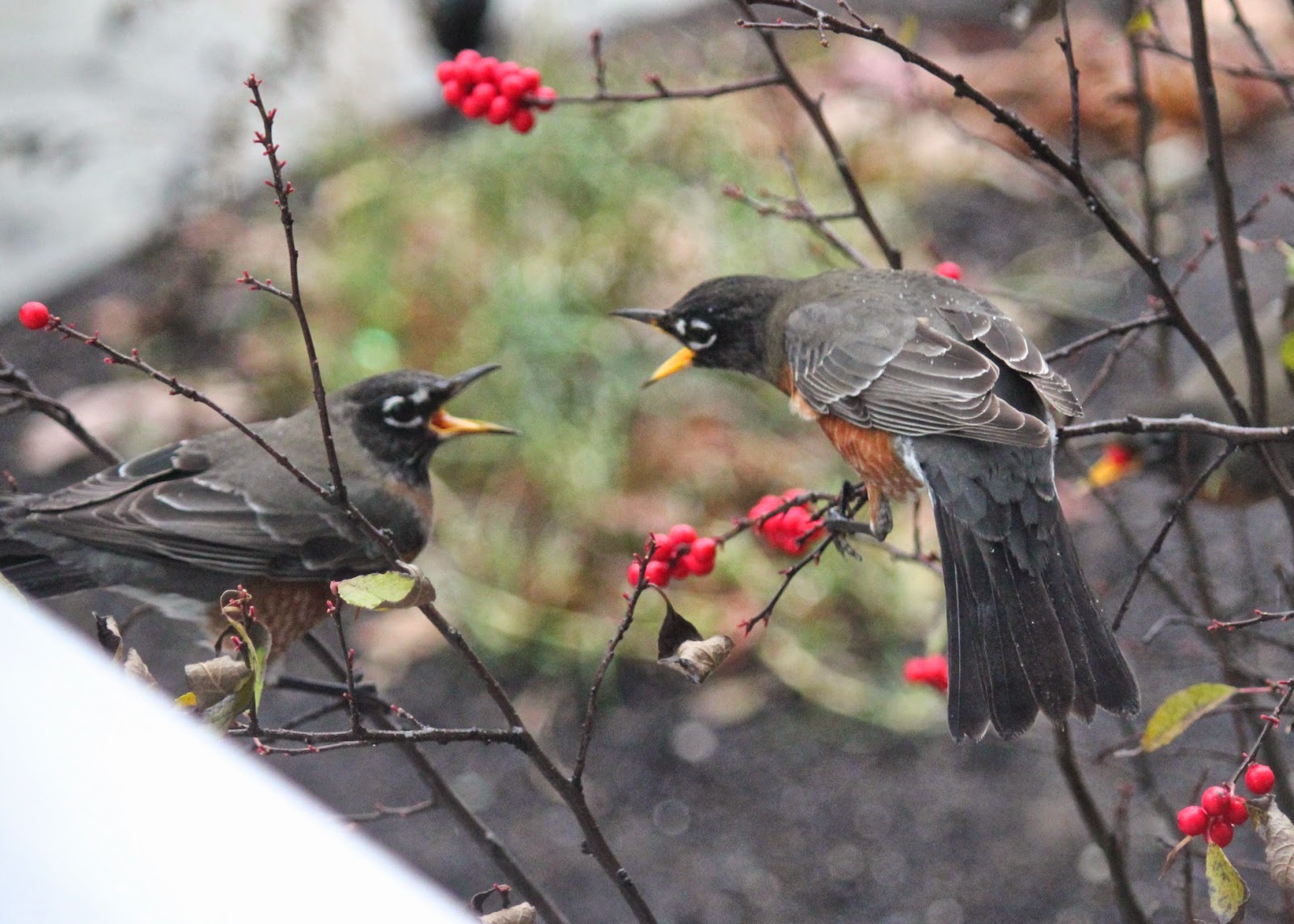
The morning before Thanksgiving, I went to the grocery store to buy some last minute ingredients for our Thanksgiving meal.  However, when I returned home, I found that the feast had already started.


A whole flock of Robins had descended on my Winterberry Holly bushes and were busy gobbling up as many berries as they could get their little beaks on.  
Apparently, the Thanksgiving feast had started early this year.


There must have been around twenty birds on my two little bushes.
Of course, with so much family at the dinner table, there were bound to be a few squabbles.


As much as I couldn't begrudge the Robins their Thanksgiving feast, it was rather sad to see all the berries go even before Christmas.  Last year they were my natural holiday decorations. 

my Winterberries last December
After the horde of Robins left, only a few, sad clumps of berries remained.
What can I say?

my Winterberries this year
I guess the early bird gets all the berries!


For those of you celebrating Thanksgiving, I wish you safe travels, and a warm and happy holiday with your loved ones!  And may all of us be thankful for our blessings.

Wednesday, September 24, 2014

Winterberry Hollies

It may be officially fall, but it's beginning to look a little like Christmas in my front yard - my Winterberry Hollies are on full berry display!

Winterberry Holly
The Winterberry Holly, or Ilex verticillata, is a shrub native to Eastern North America.  It is native to swampy areas, so, like many of our native hollies, Winterberries are great shrubs for poorly drained soil (hello, clay!).


So why are they called Winterberries?


Winterberry Hollies are actually deciduous.  Their leaves fall off, leaving just the gorgeous berries that remain over winter (thus Winterberries!)  I know many people prefer evergreen hollies, but I like the softer leaves of the Winterberries better than many of the stiff, glossy evergreen varieties.  And how gorgeous do these branches look with just beautiful red berries on them?

Random fact:  Of the 400 species of hollies in the world, only about 30 are deciduous.
Cut branches are often used in Christmas arrangements.  You don't even need to put them in water; dry cut branches will keep well for weeks.  Left outside, on the other hand, they will only last until the birds get to them!  Last year all of my berries were gone by February, but we had so much fun watching the birds while they were eating them.

I think the Winterberries attracted every Bluebird on this side of town!
Wanting shrubs with beautiful winter interest, I planted 'Winter Red' Winterberry Hollies on either side of my front door.  The cultivar 'Winter Red' is supposed to get between 6 to 9 feet tall and 6 to 8 feet wide.  Of course, being a berrying holly, 'Winter Red' is a female.  In order to get those beautiful berries, the girls need a gentleman caller, for which I have the compact 'Jim Dandy' Winterberry tucked into a corner of the yard.

('Winter Red' is actually supposed to prefer the later pollinating 'Southern Gentleman', but 'Jim Dandy' seems to do the trick for mine - either that or my girls have been seeing other males on the side, which is very possible with all the wild hollies that loiter in my neck of the woods...)

Winterberry Holly 'Winter Red'
There are quite a few different cultivars of Winterberry Holly. Some of the popular ones include the short and compact 'Red Sprite', the very berry-heavy 'Berry Heavy', and the yellow-orange berried 'Winter Gold'.

Winterberry Holly 'Winter Gold'
photo source: J. Reeves, UT Gardens
Winterberry Hollies can be grown in full sun or partial shade, but they will produce more berries with more sun.  Most cultivars are hardy from zones 3 - 9, and they have very few problems with disease.  These extremely hardy shrubs are also tolerant of air pollution, clay soil, wet soil, erosion, and zombies... (just kidding, though they are deer-resistant!)  They are relatively slow-growing shrubs, though, so it is a good thing that they are deer-tolerant!


The one thing they don't tolerate, however, is alkaline soil - only plant Winterberries in acidic soil unless you want them to turn yellow and keel over on you.  But if you are looking for a great shrub to plant this fall in one of those tough, wet, clay (and acidic) sites, Winterberry Holly just might be the ticket!


Happy Fall Gardening!