Thursday, June 26, 2014

Where Have All the Bees Gone?

In my last garden, I remember stepping out into my backyard and hearing a hum rising up from all the bees enjoying the clover and other flowers.

honeybee on clover
Two years later, I now have a new garden and a nice big patch of clover, but...


where are all the bees?

are the bees hiding from me?
Oh yes, if I search I can find a few bees..

Bumble bee on salvia
But it is worrisome.  
Is it because so many bees died off after the hard winter?
Am I seeing the effects of Colony Collapse Disorder?
Or is it because my garden isn't as established yet and hasn't been 'discovered'?

a tiny sweat bee, covered in pollen
There seem to be a lot of factors affecting bee numbers.  It is a perfect storm for bees and other pollinators out there - pesticides, pathogens, parasites, loss of habitat, and a harsh winter on top of that.

label on a bottle of Tree & Shrub 'Protect & Feed' granules
Imidacloprid and Clothianidin are Neonicotinoids, pesticides that absorbed into the plant and are suspected of being harmful to bees
In good news, though, the topic has been getting so much attention that pressure is being put on law makers.  Last week, during National Pollinator Week, the White House announced a Presidential Memorandum to address the loss of bees, monarchs, and other pollinators.  The memorandum established a task force to look into the problem and come up with a plan.  It also ordered pollinator-friendly practices to be put into effect on federal lands in order to build up habitat.

Bumble bee on holly
Well, we all know government, so we'll see how effective this will be, but at least it is a step in the right direction.

miner bee on clover
As my rather empty patch of clover knows,
the pollinators need all the help they can get!

Thursday, June 19, 2014

The Curse of a Gardening Overachiever

After the long winter, the call of the garden has been strong, and it's been a fast and furious spring gardening season these past few weeks.  

front walkway garden in early May..
...in late May
...and mid June.
Of course our big spring project has been our red veggie garden, but in addition to building, tilling soil, and hauling rocks for that garden, I've also spent quite a few afternoons digging up other areas of the yard.  I've had (and still have!) lots of seedlings to plant from my seed starting and winter sowing. 

Almost all of the seeds I winter-sowed grew quite well!
I've also received a number of plants from several generous gardeners whose gardens were overflowing (I highly recommend joining a gardening club if you love plants!)  

Have extra plants in the garden?  I'll take them!
(This one is a Campanula, I believe.)
The past few weeks have also been devoting to watering and caring for all my new little plant-lings and keeping a close eye on all the local critters (which I shall introduce to you at a later time).

Woohoo!  Snow peas!
Unfortunately, I've been so busy this spring, that, while my gardens are shaping up nicely, I've apparently overdone it.  I now have tendonitis in both wrists and am forced to hang up my shovel for a little while.

Grrr... so much I want to do!
I guess that's the problem when a new garden and an impatient, overachieving gardener meet.  I have so many grand visions of what I want my garden to look like, and of course it will take a few years to achieve anything close to that.  (I just have to keep having to remind myself of that fact!) 

But it does give me a little more time to blog now..

My Nicotiana is starting to bloom and smelling wonderful.
...and some time to slow down and actually smell some of those flowers!

Thursday, June 5, 2014

Our New Red Veggie Garden!

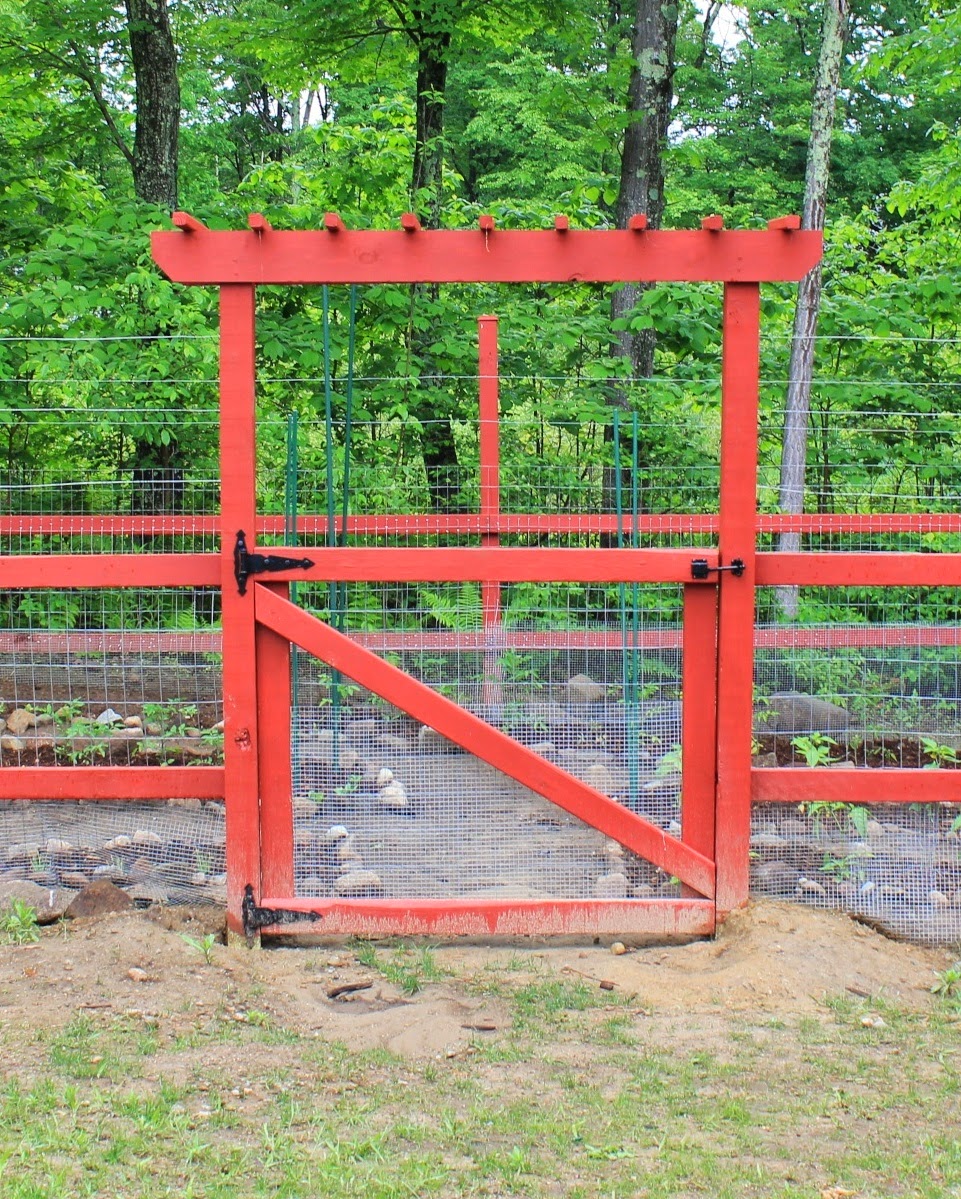
After several weeks of digging, stone excavating, building, and painting, our veggie garden is finally ready for the big reveal:


Ta da!
Our veggie garden fence is finally done! 

our (hopefully!) critter-proof veggie garden fence!
Knowing that we have rabbits, groundhogs, and deer in the area to fend off, we did our best to make our garden safe for the veggie plants.

Veggies tasty for the critters are on the inside of the fence.
On the outside are plants usually avoided, such as rhubarb and ground cherries 
The bottom part has 1/2" wire mesh to keep out the smaller critters.  We dug trenches and buried the mesh a foot down to hopefully deter the tunneling groundhogs (or, as we call them, R.O.U.S.'s).  


Larger-holed mesh covers the middle chunk, and wire is strung near the top to hopefully prevent the deer from thinking this was a free, all-you-can-eat salad buffet.


I have to give major props to the fabulous Mr. Red House, who designed and built this gorgeous arbor and gate for me!


Within, the garden holds pretty much all the components of several types of salsa, as well as a mean salad or two.  Having quite the plethora of stones after digging up the ground for the garden, the veggie beds are lined with (can you guess?) rocks.  

Our veggie garden only contains organic, hand-dug, native rocks.
'Cause that's the way we roll...
There is still a little more stone-moving and filling up of ditches to be done, but I'm so happy that the garden is pretty much done and the veggies are in the ground!


Happy gardening!

Thursday, May 29, 2014

A Little Butterfly? A Tiny Plane? No, it's a Polygala paucifolia!

It's our first spring here in this house, and I have been excited to see what comes up in the woodlands in our yard.  So far some beautiful native plants and wildflowers have started making an appearance - Cinnamon Fern, Starflower, False Lily-of-the-valley, and wild Violets.  Then I stumbled (quite literally, oops!) into a patch of these while walking through our woods:

Polygala paucifolia
I have a little colony of Gaywings growing in my woods!  Polygala paucifolia, also known as Gaywings, Fringed Polygala, or Flowering Wintergreen, are short, little plants, easy to miss unless you look down.. (or trip and fall into them..)

Gaywings, spring-blooming wildflower
Gaywings are native to Eastern North America, growing from Canada down to the Georgia mountains.  They spread on creeping, partly underground stems, and are generally found in moist, acidic, wooded sites.  They bloom in May or June, and the winged flowers are often compared to butterflies or even little pink propeller airplanes.

Looks like a field of little tiny airplanes?
Or a bunch of little pink butterflies, alighting on some leaves?
The 'wings' of the flower are actually made up of sepals.  Each flower does have three petals, two of which form a tube around the reproductive structures.  The third petal is fringed, looking like a propeller for the airplane-shaped flower.  When a bee or other pollinator lands on this third petal, the weight opens up the tube, allowing access to the pollen (or cockpit, if we're still going with the airplane motif?).

ready for takeoff...
The resulting seeds are actually planted by ants.  The seeds have little attachments on them called elaiosomes, that are very rich in nutrients.  Ants like to feed these elaiosomes to their young, and in doing so they end up carrying the seeds off and 'planting' them in their ant nests.

And just in case the insects fail to pollinate the flowers and make any seeds, each plant also has a couple of tiny, inconspicuous flowers that are underground and self-fertilized.


Polygala paucifolia is in the Milkwort family, and people once believed that if they fed the leaves of this plant to nursing mothers or dairy cattle, they would produce more milk (in Latin, 'poly' means 'many or much' and 'gala' means 'milk').

yum, yum..
According to online reports, Gaywings are a little hard to get established, but when they are happy, they will make a nice colony.  I think they would make a beautiful clump of ground cover for a woodland garden, as the leaves stay mostly evergreen.


Polygala paucifolia is honestly quite hard to find if you are hoping to get some for your garden.  I can't find many reports of people propagating these from seeds, or really, too many reports of propagating these at all.  The main suggestions seem to be propagation from stem cuttings or by carefully dividing the rootstock.  I only found one online source for them: Enchanter's Garden Native Plant Nursery in Hinton, WV (maybe someone else knows of other sources?)  You could also try a local wildflower nursery.


For now, I am enjoying them where they are in the woods!

p.s. For a look at other wildflowers that are blooming this May, visit this month's Wildflower Wednesday at Clay and Limestone's blog!

Tuesday, May 20, 2014

Stone Soup, Anyone?

We haven't even finished building our veggie garden, and we already have an overabundance of our first crop.  


This crop seems to grow a little too easily in this area, as we have harvested dozens in just a small section of soil.  Some even seem to be growing one on top of the other!


While we do love this particular crop, it is pulling them out that is the problem. Some come out easily; others seem to have very deep roots indeed.  

  
It is somewhat exciting - these didn't grow nearly as big or in so much abundance in my previous garden in North Carolina.  If only they weren't so hard to harvest...


A few had grown so large that it took the efforts of both Mr. Red House and I to uproot them. And then there was the Big One.  It had roots so deep, that it defied both our efforts.  (We decided it was quite fine staying where it was.)


Anyone up for some Stone Soup?  You just have to dig a little... (or a lot!)

Monday, May 12, 2014

Seedlings-in-waiting

Back in February and March, when snow was still coming down and piling up on the ground, this gardener was eager to do something for the garden, so I started planting packets of seeds indoors in my guest room conservatory.

Sorry Mom and Dad, you don't mind sharing your room with the plants when you come to stay, right?
Well, now I have seedlings.. and lots of them!

pepper seedlings
I have seedlings in my guest room conservatory..


seedlings on my deck..

tomatillo seedlings
seedlings in my garage..


I think I might have gone a little overboard.


Some of these seedlings are destined to a local garden club's plant sale and some to friends and family.  We'll see if I can find room in my yard for all that will still be left!

Tomato seedling - one of about 492.  Okay, maybe not that many, but there's a lot!
Of course, for the past few weeks, we have all been waiting for that magic Last Frost Date.  It is now within sight, and it is so warm out, that I could probably start planting now..

Isn't this one of the best uses for the red Solo cup?
...except all of my spare time is being used to work on building our awesome new Veggie Garden!
Stay tuned...
And happy planting!

cucumber seedlings in newspaper pots
p.s. Anyone want a tomato seedling?  I have a few to spare...